
Breaking the Shell: What Refugee Life Taught Me About Humanity
Karl Balloch
I grew up in a small village in Balochistan where almost everyone knew everyone else.
We spoke the same language. We celebrated the same festivals. Not only that, but we followed the same customs and traditions. ALL people belonged to the same ethnic background and shared similar beliefs about life, family, and society.
As a child and later as a young man, I never thought much about it. To me, that was simply how the world worked.
Looking back today, I realize that I was living inside a small circle without even knowing it.
There was comfort in that circle. There was security. There was a sense of belonging. When everyone around you shares the same language, culture, and social values, life feels familiar and comfortable.
There is nothing wrong with that.
But life has a way of teaching lessons that cannot be learned from books or classrooms.
Sometimes those lessons are learnt through unexpected journeys.
I have learnt those lessons through becoming a refugee. At the time, I could not see any gift hidden inside that experience. I saw only loss, uncertainty, and fear.
When Life Takes You Beyond Familiar Borders
Like many refugees around the world, I did not leave my homeland because I wanted adventure or a new life abroad.
I left because circumstances forced me to do so.
Leaving behind familiar places is not easy. Leaving behind dear ones is even harder.
I still remember the feeling of uncertainty. The questions that had no answers. The fear of not knowing what the future would look like.
One memory from that uncertain time still brings me warmth. Before arriving in Finland, I had a long sojourn in Sri Lanka, where some amazing Sri Lankans, Australians, New Zealanders, and a few other refugees poured out their love and care to beat our loneliness. I recall my long interview with the UNHCR officers, Mr. Joseph Carol and Ms. Sanjitha Satyamurthy, in Colombo. These young officers were full of kindness and compassion, and amazing understanding. They listened to my story not like officers processing paperwork, but like human beings who truly cared. Although they asked critical questions, they never rushed me. When I struggled to explain something painful, they simply waited, their eyes full of patience and care. That day, I learned that authority and humility can exist in the same person. The UNHCR officers did not just process my case. They made me realize that they saw my pain, and that seeing gave me strength for the journey ahead.
When I eventually arrived in Finland as a quota refugee, everything felt unfamiliar.
The language was different.
The weather was different.
The food was different.
The social rules were different.
I remember our landing at Helsinki Airport. We stepped off the plane exhausted and disoriented. And there were, workers from SPR, the Finnish Red Cross. They held simple signs with our names. They warmly welcomed us and spoke slowly, using hand gestures and broken English, trying to make us feel less alone in that cold, bright terminal. If we were supposed to find our own way and were left alone, how could we have managed? We were disoriented and afraid. Their presence was a great source of comfort.
Yet it was during those difficult years that I discovered something that changed my understanding of people forever.
The Kindness of Strangers
As I have mentioned earlier, back in my village, all relationships were naturally built around familiarity.
People knew one another through family connections, language, religion, community, or long-standing friendships.
But refugee life introduced me to a different reality.
The people who helped me in Finland were not from my village.
They did not speak my mother tongue.
They did not share my cultural background.
Many did not share my religious beliefs.
Yet they helped me.
I met teachers who patiently guided newcomers.
I met officials who helped me understand systems that were completely unfamiliar to me.
I met neighbours who showed kindness through simple acts.
I met ordinary people who treated me with dignity even though they knew very little about me.
In Riihimäki, our host city, the first social worker was Ms. Jutta Peltonen. She helped us with paperwork and appointments, but she did something more. She tried to learn how to pronounce my name correctly. She treated me not as a case number but as a person with a past and a future. Sometimes she stayed beyond working hours just to make sure we understood everything.
What truly saved me from loneliness, however, were the church volunteers and SPR volunteers at Suomi Kahvila and Luetaan Yhdessä. They came to help us learn Finnish language, but they ended up giving us something MORE: friendship, personal time, and attention. They expanded their care and attention beyond office hours. Pirjo and Ari Viitanen took us to their home and had a barbecue at their summer cottage. Ari was the first to teach me the rituals of Finnish ‘sauna.’ Helena Syrjälä took me to her home and church. Eeva Liisa showed us the walking trail. Eero Haltia drove us to attend and participate in events and speak on occasions. How can I miss Jouni and Ulla Lätti, who have given all their valuables for my comfort? They drank coffee with us, taught us Finnish words through laughter, and listened to our broken stories with patient hearts. They became a shield against the isolation that so often surrounds newcomers. Even after we grew familiar with Riihimäki, they remained. They did not vanish when our Finnish improved. These people are not just names or one-time experiences. We are still continuing our friendship and meetings from our early days until now. They have seen my growth. They see their contributions.
What touched me most was this: they helped not because I belonged to their community, but because they believed helping another human being was the real joy.
For someone like me, who had spent most of his life within one cultural environment, this was a powerful lesson.
And yet, I will be honest. There were days when I felt embarrassed because I could not express myself in Finnish, and I felt like an unwanted guest. Those moments were hard. They made me question whether I would ever belong. But even in those low moments, the kindness of others reminded me that my worth was not measured by my language skills but in my efforts, involvement and interest in learning and developing.
Finland Taught Me Something Important
I often remind myself that I did not arrive in Finland because I won a competition.
I did not arrive because I had extraordinary qualifications.
I did not arrive because I possessed special talents that made me stand out.
I arrived because I needed protection.
Finland accepted me through an international commitment to protect people who could no longer safely remain in their homeland.
That realization has stayed with me throughout the years.
It taught me that some of the most important acts of kindness in this world are not based on what a person can offer in return.
Sometimes kindness is given simply because another human being needs it.
That lesson strengthened my faith in humanity.
Human Values Are Universal, But Their Expressions Are Different
Living in different cultures also taught me another valuable lesson.
Many human values are universal.
Love is universal.
Respect is universal.
Compassion is universal.
Care is universal.
But the way these values are expressed often differs from one culture to another.
I remember seeing something in South India and Sri Lanka that many people from those regions would understand immediately.
Sometimes a wife feeds her husband by hand during a meal. It is seen as an expression of affection, care, and closeness.
The act itself carries a positive meaning.
But imagine the same scene in a restaurant in Helsinki.
Many people might interpret it differently. Some may assume the husband has a physical disability and needs assistance.
The message of affection could be misunderstood because the cultural context is different.
The value remains the same.
The expression changes.
This taught me an important lesson about integration.
Integration does not mean abandoning our values.
It means learning how to express those values in ways that are understood within the society where we live.
The roots remain the same, even when the branches grow in a different direction.
The Shell That Had to Break
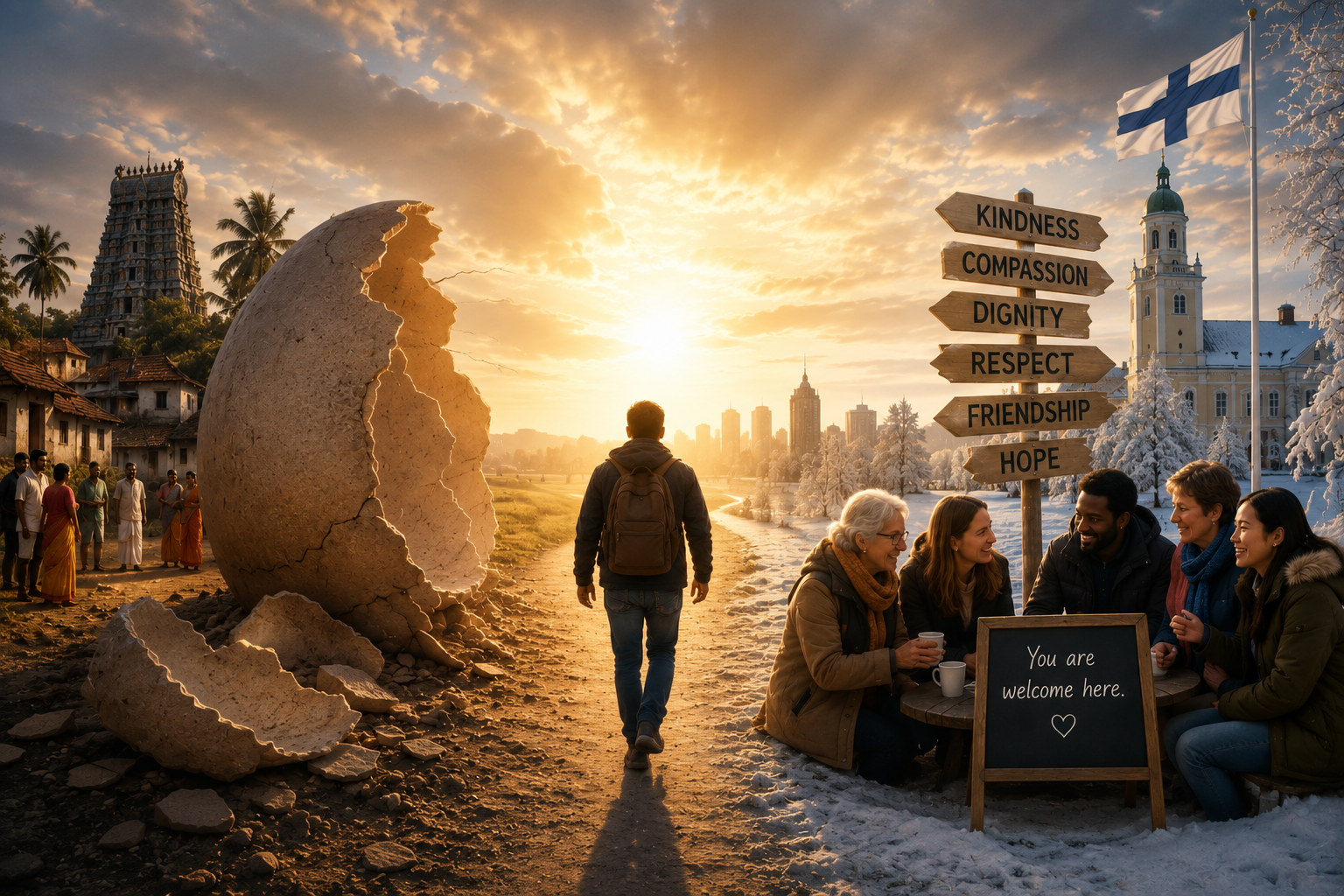
As I reflect on my refugee journey, I sometimes think of it as a shell that had to break.
The first shell was my village mind set.
The second shell was my region and its specific etiquttes
The third shell was my culture.
The fourth shell was my assumption that care and honour depend on the same race, region, and religion.
Before becoming a refugee, most of my meaningful relationships existed within familiar boundaries.
That is natural. Most people around the world live this way.
But refugee life pushed me beyond those boundaries.
Before becoming a refugee, I naturally trusted people who were familiar to me. People who spoke my language. People who understood my customs. There is nothing wrong with that. But refugee life taught me that trust can also grow between complete strangers. Some of the people who helped me most had almost nothing in common with me except our shared humanity.
BECOMING A REFUGEE forced me to meet people I would never otherwise have met.
It forced me to learn from people whose experiences were entirely different from my own.
Not only that, but it forced me to see that humanity is much larger than any one group, culture, language, or nation.
And then something wonderful happened. As I settled into my new life, I began finding my friends from various backgrounds: Finns, Swedes, Sami, Sri Lankans, Indians, Turks, Brits, Poles, Africans, Slovaks, Serbians, Estonians, Nepalis, Iranians, and many others. They were fellow humans. We shared meals, went fishing, and went holidaying. We celebrated each other’s first victories, promotions, and birthdays. We cried together on hard days. These friends did not come from my village or my background, but they became family. Meeting them reshaped my thinking completely. I no longer believed that trust must begin with similarity. I learned that relationships can grow anywhere two human beings are willing to be honest and kind.
Becoming a refugee did not make me love my roots any less.
It simply helped me see a wider horizon
The Gift Hidden Inside a Difficult Journey
I would never describe refugee life as easy.
It involves loss.
It involves uncertainty.
It involves sacrifice.
It involves rebuilding parts of life that once seemed permanent.
But hidden inside those struggles was an unexpected gift.
My understanding of humanity expanded.
I learned that kindness does not require a common language.
Compassion does not require a shared religion.
Respect does not require a shared ethnicity.
Human beings are capable of caring for one another even when they come from completely different backgrounds.
That realization may be the most valuable lesson my refugee journey has given me.
A Responsibility Born from Gratitude
Today, when I think about the opportunities I have received and the people who helped me along the way, I feel gratitude.
That gratitude also brings responsibility.
The kindness shown to me should not stop with me.
The compassion I received should continue through me.
When I meet someone who is struggling, I try to remember the strangers who once helped me.
When I meet someone who feels alone, I remember what it felt like to be new in a foreign land.
When I meet someone in need, I try to look beyond labels and see the person first.
After all, that is what others did for me.
A World Refugee Day Reflection
World Refugee Day is often a time to remember suffering, displacement, and loss.
Those realities should never be forgotten.
But this year, I also choose to remember something else.
I remember the people who helped me when they had no reason to do so except that I was another human being in need.
I remember the compassion that crossed borders.
I remember the kindness that crossed languages.
I remember the humanity that crossed cultures and beliefs.
My refugee journey took me far away from the place where I was born.
But it also brought me closer to a larger understanding of what it means to be human.
The greatest gift I found on that journey was not simply safety.
It was the breaking of a shell.
A shell of limitations.
A shell of assumptions.
A shell that once defined the boundaries of my understanding.
Today, I still value my culture, my roots, and my heritage.
But I have also learned something larger.
Our deepest connection is not our nationality.
It is not our ethnicity.
It is not our language.
It is not even our region.
Our strongest connection is our shared humanity.
And that is a lesson worth carrying for the World Refugee Day.